WikiGacha's Free-to-Play Success: Redefining Digital Card Games
The digital gaming world is a constantly evolving landscape, often characterized by innovative projects that capture global attention. Among these, few have sparked as much public imagination and discussion as WikiGacha. This unofficial collectible card game (CCG) has taken a unique approach, transforming the vast repository of Wikipedia entries into an engaging, free-to-play digital trading card experience. Its meteoric rise, marked by significant traffic surges and enthusiastic player reception, signals a compelling shift in how digital card games can operate, proving that success doesn't always require aggressive monetization.
In an era where "gacha" mechanics are often synonymous with financial risk and randomized loot boxes, WikiGacha stands as a refreshing anomaly. It harnesses the thrill of discovery and collection, providing an alternative that prioritizes accessibility and educational engagement over commercial gain. By leveraging real-world knowledge and historical figures as its core content, this project, affectionately dubbed "Wikipedia Gacha," exemplifies the power of educational gamification, repurposing encyclopedic data for pure entertainment and learning.
The Revolutionary Free-to-Play Model of WikiGacha
At the heart of WikiGacha's unprecedented success lies its utterly free-to-play model – a radical departure from the industry standard. Unlike many mainstream titles that rely on microtransactions, season passes, and randomized loot-box mechanics, WikiGacha vs. Gacha Games: The Free Pull Revolution is built on a foundation of genuine player accessibility. Players don't spend a dime; instead, they are empowered to build their collections through freely earned daily packs.
This approach fundamentally redefines the player experience. Without the pressure of monetary investment, the act of opening packs becomes a pure thrill of discovery. There are no "pay-to-win" dynamics, no expensive rare cards locked behind paywalls, and no compulsion to spend beyond a player's means. This ethical framework has resonated deeply with a global audience tired of aggressive monetization strategies prevalent in many modern digital card games.
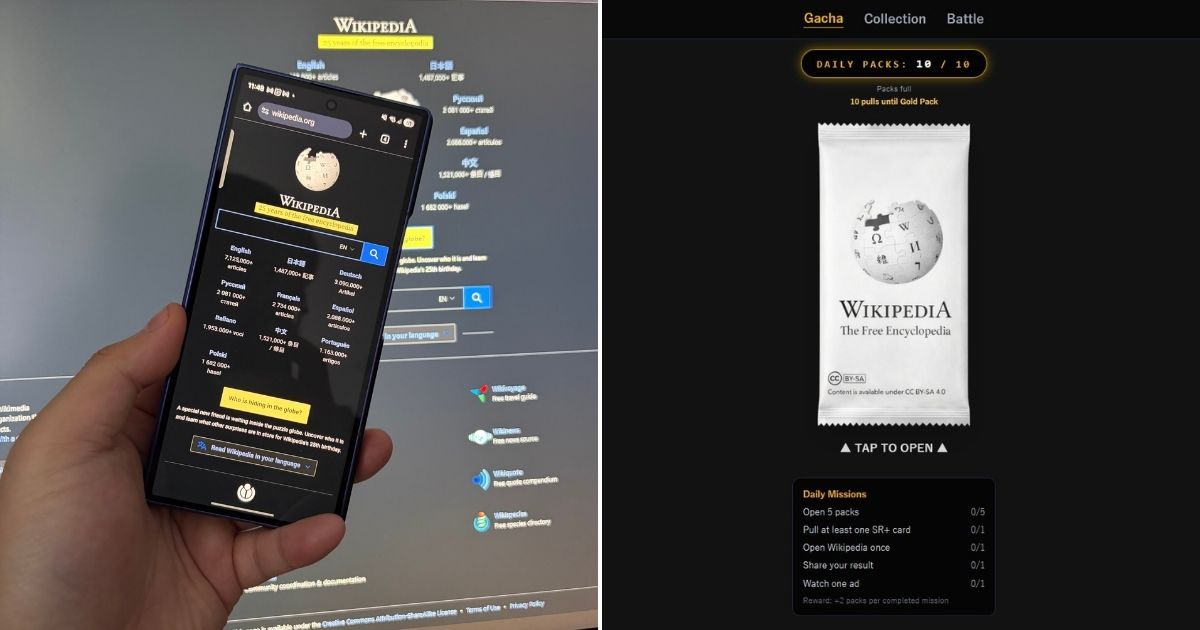
The game ensures a steady stream of new cards by allowing players to hold a maximum of 10 packs at any given time, which can be acquired simply by engaging with the game. This thoughtful design encourages consistent participation without demanding excessive playtime or, more importantly, financial commitment. It fosters a community built on shared discovery and strategic gameplay rather than financial superiority, creating a level playing field for everyone.
Wikipedia as Your Card Collection: The Brilliance of Educational Gamification
Imagine turning the world's largest encyclopedia into a dynamic, collectible trading card game. This is the simple yet profoundly addictive premise that underpins WikiGacha. Every single Wikipedia page is a potential card for players to collect, ranging from obscure historical figures and scientific concepts to famous landmarks and cultural phenomena. This innovative use of an existing, vast knowledge base provides an almost infinite number of unique digital trading cards.
This ingenious concept transforms learning into entertainment. As players open packs and discover new cards, they are not just adding to a digital collection; they are encountering snippets of real-world knowledge. Building "battle systems" in WikiGacha becomes an exercise in strategic thinking combined with a surprising dose of general knowledge. Players learn to connect disparate facts, understand historical contexts, and appreciate the interconnectedness of information – all while having fun. This "educational gamification" is a powerful trend, demonstrating how encyclopedic data can be repurposed to engage and educate in a novel way.
The sheer breadth of possible cards means that every pack opened offers genuine surprise and the potential for a truly unique addition to one's collection. One might discover a card representing a forgotten monarch, a groundbreaking scientific theory, or a peculiar cultural tradition, prompting further exploration of its corresponding Wikipedia page. This organic encouragement of learning is a core pillar of WikiGacha's appeal.
Subverting Gacha: A Risk-Free Thrill
The term "gacha" originates from "gashapon," the Japanese vending machines dispensing random capsule toys. In the digital realm, this concept evolved into a sophisticated, often controversial, monetization model. High-revenue titles like Gacha Club and various simulators dominate a market where players spend real money for a chance at obtaining rare digital items, often without transparency regarding "drop rates" – the mathematical probability of getting a specific item.
WikiGacha masterfully subverts this model. It retains the addictive "thrill of the pull" – the excitement of opening a pack and seeing what random card appears – but completely decouples it from any financial risk. Players experience the satisfaction of discovery, the surprise of a rare find, and the joy of expanding their collection without the anxiety or regret associated with monetary spending. This fundamental difference is a key reason for its widespread appeal; it offers the pure, unadulterated pleasure of a gashapon machine without the potential for financial loss.
The platform's success highlights a growing appetite among gaming communities for more ethical and player-friendly experiences. Recent data suggests a migration away from traditional, ad-heavy platforms towards community-driven initiatives that prioritize data integrity and user experience. WikiGacha, as a fan-led, non-commercial venture, perfectly aligns with this ethos, showcasing that a game can thrive by putting its community and their enjoyment first, rather than focusing on profit maximization.
Building Your Battle System and Collection: Tips for Aspiring WikiGacha Collectors
The journey in WikiGacha is all about building the ultimate collection and crafting strategic "battle systems." With every Wikipedia page acting as a potential card, the possibilities are virtually endless. The core loop revolves around acquiring and opening packs, a process designed to be entirely free and accessible. WikiGacha Pack System: How to Get More Free Wikipedia Cards delves deeper into the specifics, but here are some practical tips for new and aspiring collectors:
- Consistent Engagement: The game's design encourages regular, short bursts of play. Since you can hold a maximum of 10 packs at any given time, logging in daily to earn and open new packs is the most efficient way to expand your collection without feeling overwhelmed.
- Understand Card Rarity: While all cards are free, some Wikipedia entries are naturally rarer or more unique than others. Pay attention to card descriptors and categories. Discovering an extremely niche or historically significant entry can be a rewarding experience.
- Strategic Battle System Building: Don't just collect randomly. Start thinking about how different cards, representing real-world knowledge or historical figures, might interact in a "battle system." Are there cards that share common themes, historical periods, or scientific principles? Building synergistic decks based on these connections can add a layer of intellectual challenge.
- Community Exploration: Engage with the WikiGacha community. Players often share their unique card finds, offer strategies for battle systems, and discuss interesting Wikipedia entries. This social aspect enhances the educational and entertainment value of the game.
- Embrace Discovery: One of the greatest joys of WikiGacha is the unexpected knowledge you gain. Don't shy away from exploring the Wikipedia pages linked to your new cards. You might stumble upon fascinating facts or concepts you never knew existed.
Unlike traditional CCGs where strategy often involves understanding complex rule sets and card abilities, WikiGacha's strategic depth emerges from your understanding of real-world relationships and context. This makes it not only a game but also a subtle and engaging tool for expanding your general knowledge.
Conclusion
WikiGacha's free-to-play success story is a compelling testament to innovation and a clear indicator of evolving player preferences in the digital gaming sphere. By transforming the vastness of Wikipedia into a collectible, tradable card game, it has carved out a unique niche that appeals to both avid gamers and curious learners alike. Its ethical approach, devoid of aggressive monetization and focused on accessible, risk-free fun, offers a refreshing alternative to traditional gacha mechanics and loot-box models.
The platform's journey, from facing overwhelming traffic to fostering a vibrant, knowledge-driven community, highlights a significant demand for games that prioritize engagement, education, and pure enjoyment over financial extraction. WikiGacha isn't just a game; it's a phenomenon that redefines what a digital card game can be, proving that the most successful ventures often put the player experience—and the pursuit of knowledge—first.